The Four Blocks That Feel Completely Different on a UT Game Day
At five o’clock on a normal Saturday morning, downtown Knoxville is quiet enough to hear delivery trucks turning onto Gay Street.
On a Tennessee football Saturday, the city is already changing.
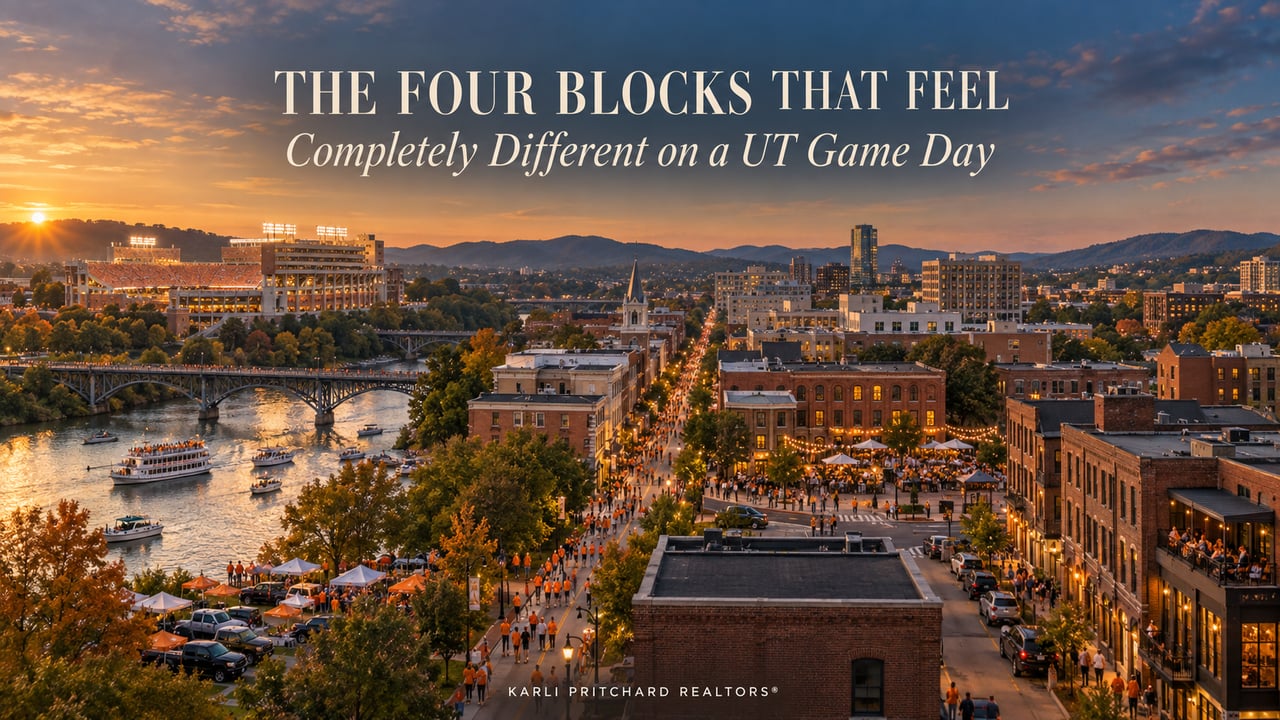
Roads near Neyland Stadium begin closing. Parking spaces that sat empty overnight acquire event rates. Tailgating supplies appear in condo elevators. By midmorning, orange shirts are moving south toward the river from Market Square, the Old City, and every public garage between them.
More than 100,000 people may ultimately gather inside Neyland Stadium. Thousands more will spend the day in restaurants, bars, parking lots, boats, condos, and sidewalks surrounding it.
From outside Knoxville, downtown can look like one compact neighborhood beside the University of Tennessee. On a map, the distance between the riverfront and the Old City is barely more than a mile.
On game day, that mile divides into several entirely different places.
The closer a condo sits to the stadium, the more directly it absorbs the traffic, noise, and pedestrian movement. Move several blocks north, and the crowd changes from people headed to their seats into people watching from restaurants and short-term rentals. Continue toward the Old City, and the stadium itself begins to disappear even while the game-day economy remains.
Four blocks—or four downtown micro-markets—can produce four completely different Saturdays.
Block One: Volunteer Landing and the Riverfront
The riverfront is where Tennessee game day becomes physical.
The Vol Navy begins arriving by water. Boats gather along the Tennessee River near Neyland Stadium, turning a normally quiet stretch into one of college football’s most recognizable traditions. Pedestrians follow the greenway and riverwalk toward the stadium while vehicles compete for the limited routes that remain accessible.
This is the part of downtown where proximity provides the greatest reward and creates the most disruption.
A resident may be able to walk to Neyland Stadium without moving a car or crossing most of downtown. From certain river-facing properties, the buildup becomes part of the view. Boats arrive, music carries across the water, and the stadium seems close enough to function as an extension of the neighborhood.
The same location can make driving difficult.
Traffic plans change around major stadium events, and Neyland Drive is used strategically to move large numbers of vehicles before and after the game. Roads immediately surrounding the stadium close early, and postgame traffic can be redirected to clear the area more efficiently.
For a resident with dedicated parking, that may be manageable. For someone depending on public parking or expecting guests, it requires planning.
The noise also lasts longer than the football game. The riverfront begins changing hours before kickoff and does not return to normal when the clock reaches zero. Boat traffic, music, pedestrians, vehicle horns, and postgame celebrations can continue well into the evening.
For a short-term-rental guest, that intensity may be the main attraction. For a full-time resident trying to leave for dinner or sleep after a night game, it is part of the tradeoff.
This block provides the most immersive version of game day downtown. It also asks residents to surrender the most control over their immediate surroundings several Saturdays a year.
Block Two: South Gay Street, Church Avenue, and the Walk Toward Neyland
A few blocks north of the riverfront, the stadium no longer controls every view—but it still controls the sidewalks.
The southern portion of Gay Street and the streets around Church Avenue, Main Street, and the Tennessee Theatre sit directly in the pedestrian path between central downtown and Neyland Stadium.
This is where game day arrives on foot.
Restaurants fill before their typical weekend rush. Groups stop for breakfast or drinks before continuing south. Hotel guests emerge in orange. The closer kickoff gets, the more consistently the crowd moves in one direction.
The advantage is obvious: residents can participate in nearly everything without getting into a car. They can walk to restaurants, meet friends, continue to the stadium, and return home after the game while thousands of drivers remain in traffic.
The disadvantage is that the building’s front door may open directly into the flow.
Sidewalk noise, street conversations, music, and postgame crowds become more noticeable than they are several blocks north. Guests may struggle to reach the building by car. Food-delivery times become unpredictable. A normally simple trip across downtown may require a route that avoids the heaviest pedestrian areas.
Parking depends heavily on what conveys with the condo.
A deeded or reserved space can make ownership much easier. A unit without dedicated parking may require a monthly arrangement in a public or private garage. Even when the owner has somewhere to park, reaching that space during the busiest part of game day may be the real challenge.
This block creates one of the best balances for owners who want walkability to Neyland without living directly on the riverfront. But “close enough to walk” also means close enough to experience the crowd coming and going.
Block Three: Market Square and Wall Avenue
Market Square does not feel like the stadium district on an ordinary day.
On game day, it becomes the gathering room.
The square fills with people eating before kickoff, meeting friends, shopping, watching other games, or staying downtown without holding a ticket to Neyland. Bars and restaurants absorb the crowd, and the area can remain busy even while most ticket holders are inside the stadium.
This is a different kind of game-day activity from the riverfront.
At Volunteer Landing, people are moving toward one destination. On Market Square, they spread out and stay. The result is more sustained restaurant and sidewalk activity before, during, and after the game.
For condo residents directly on or beside the square, the atmosphere may be the reason they purchased there. They can walk downstairs into the center of downtown, watch the crowd change throughout the day, and reach the stadium without dealing with parking.
The same location creates a different noise profile.
The loudest sound may not be the stadium. It may be live music, patio conversations, televisions inside nearby bars, or people leaving restaurants after the game. A night kickoff can extend that activity well past midnight.
Windows, floor level, building orientation, and bedroom placement make a major difference. A unit facing the square can feel completely different from one facing an interior courtyard or the opposite side of the building.
Parking is also less straightforward than the map suggests.
Market Square Garage is exceptionally convenient during an ordinary week, and city garages provide accessible downtown parking. On football weekends, however, downtown spaces are in higher demand and event-related conditions may apply. Residents without dedicated parking are sharing the same system with thousands of visitors who have chosen Market Square as their starting point.
This is also one of the downtown locations where short-term-rental demand can become especially visible. Guests want to be close to restaurants and within walking distance or shuttle reach of the game. That can produce busy elevators, rolling suitcases, late arrivals, and a constantly changing population inside buildings where rentals are permitted.
The address may be only several blocks from South Gay Street. The experience is less about moving to Neyland and more about living inside the party surrounding it.
Block Four: The Old City and Jackson Avenue
By the time the walk reaches Jackson Avenue and Central Street, Neyland Stadium feels farther away.
Game day does not disappear. It changes form.
The Old City already has its own nightlife, restaurants, breweries, and weekend visitors. Football adds another layer rather than creating the entire atmosphere. Orange shirts appear at brunch. Short-term-rental guests arrive with coolers and clear stadium bags. Bars fill before kickoff, but not every person on the sidewalk is necessarily headed to the game.
This part of downtown can be especially appealing to buyers who want access to UT weekends without living in the most concentrated stadium traffic.
Interstate connections may feel more direct, depending on the building and route. The stadium crowd is less likely to pass directly beneath every window. Residents can still reach Market Square on foot and use game-day transportation rather than driving toward campus.
For the 2026 football season, Knoxville Area Transit operates a Market Square shuttle for every home game and offers Old City service for select games, with its Old City pickup on Willow Avenue near Covenant Health Park. That service reinforces an important difference: from this part of downtown, game day is often something residents travel into rather than something that completely surrounds the building.
The tradeoff is nightlife.
A condo removed from stadium noise may sit closer to late-night bars, patios, live music, trains, or other Old City activity that occurs throughout the year. A quieter football experience does not always mean a quieter overall location.
Short-term rentals can also have a strong presence in certain Old City buildings. Historic lofts, exposed brick, walkability, and proximity to dining make the area attractive to weekend visitors. But rental rights are determined by city permitting requirements and each building’s governing documents—not simply by the fact that other units appear online.
For an investor, the Old City may provide appeal beyond the seven or eight home football weekends. For a full-time resident, that can mean more year-round activity than a location whose busiest days revolve primarily around the UT calendar.
This block feels connected to game day without being controlled entirely by it.
Four Blocks, Four Different Parking Problems
“Does the condo include parking?” sounds like a yes-or-no question.
Downtown, it rarely is.
One unit may convey with a deeded space. Another may include the right to use a designated lot without transferring ownership of the space. A third may rely on a monthly garage lease. A fourth may have no parking arrangement at all.
Game day exposes the difference.
A deeded space is valuable, but owners still need to know whether road closures affect access to the garage. A nearby public garage is convenient, but visitors and event traffic increase demand. A surface lot may be easy to enter before kickoff and difficult to exit immediately afterward.
Guest parking creates another layer. The owner may have a reliable space while friends, renters, cleaners, or maintenance providers do not.
That is why the walking distance between a condo and Neyland Stadium tells only part of the story. The more important question may be whether the owner can reach the building—or leave it—during the five hours surrounding kickoff.
The Noise Cannot Be Measured From the Lobby
Downtown buyers often test a condo’s noise level during a weekday showing.
That reveals almost nothing about a Saturday night after an SEC game.
Noise changes by floor, window quality, building construction, orientation, and proximity to restaurants. A concrete historic building may handle sound differently from newer construction. A bedroom facing an alley may be quieter than a living room overlooking a popular patio, even inside the same condo.
The timing matters too.
Near the riverfront, activity may begin early with tailgates and boat arrivals. Along South Gay Street, pedestrian noise builds as people move toward the stadium and returns all at once after the game. Market Square maintains a more constant level of activity throughout the day. The Old City may become loudest later, after fans have returned from Neyland.
There is no universally quiet downtown game-day location.
There are simply different kinds of noise at different hours.
Short-Term Rentals Change the Building From the Inside
Football weekends affect a condo building even when the stadium cannot be heard from the unit.
In buildings where short-term rentals are legally permitted, game day can fill hallways, elevators, parking areas, and common spaces with temporary guests. That may be positive for an owner who purchased specifically for rental potential. It may feel different to someone who expected a primarily residential environment.
The distinction cannot be determined by looking at Airbnb listings alone.
Knoxville requires short-term-rental permits, and non-owner-occupied rentals are subject to location-based requirements. The condominium’s declaration, master deed, bylaws, rules, and amendments may impose additional restrictions. Financing and insurance can create further considerations.
A building may permit short stays today and change its internal rules later through the processes allowed in its governing documents. A permit held by one owner may not automatically transfer with the sale.
For downtown buyers, “Can this be an Airbnb?” is not a neighborhood question. It is a unit-by-unit, building-by-building, and permit-specific question.
Game day simply makes the consequences more visible.
Pedestrian Activity Can Be an Amenity or an Obstacle
The same crowd can increase one condo’s appeal and reduce another’s convenience.
A buyer who wants to attend every home game may place enormous value on walking out the front door and joining the stream toward Neyland. A resident who works weekends may see the same sidewalk activity as something to navigate around.
The direction of pedestrian movement changes by block.
At the riverfront, activity converges on Neyland. Along South Gay Street, it becomes a moving corridor. On Market Square, it gathers and lingers. In the Old City, it disperses through restaurants, rentals, parking, and shuttle stops.
Those patterns affect more than noise. They change restaurant waits, elevator traffic, rideshare pickup points, pet walks, grocery deliveries, and the amount of time needed to cross a few streets.
Walkability is one of downtown Knoxville’s greatest advantages.
On game day, it is also the mechanism that brings the crowd directly past certain front doors.
What the Four Blocks Actually Mean
Put the pieces together and “downtown Knoxville condo” becomes far too broad a category.
The riverfront offers the most immersive connection to Neyland, along with the greatest traffic disruption. South Gay Street sits inside the pedestrian route, making the stadium highly accessible while placing residents in the crowd’s path. Market Square functions as the social center, with sustained restaurant activity and a stronger short-term-rental presence in certain buildings. The Old City remains connected to football while maintaining a separate nightlife and visitor economy of its own.
None of these locations is automatically better.
The right one depends on whether a buyer wants to hear game day, walk through it, host it, rent to it, or remain close enough to enjoy it without having it directly outside the bedroom window.
That distinction cannot be found in the square footage, listing price, or phrase “walking distance to Neyland Stadium.”
It requires knowing the block, the building, the parking arrangement, the direction of the windows, and what happens outside the front door when 100,000 people arrive downtown at once.
If you are considering a downtown Knoxville condo, Karli Pritchard can help you compare more than finishes and price per square foot. We look at parking rights, HOA restrictions, short-term-rental rules, building orientation, pedestrian patterns, and what each part of downtown feels like during both an ordinary week and the busiest UT football Saturday.
Schedule a personalized downtown Knoxville condo consultation to find the building—and the block—that fits how you actually plan to use it.